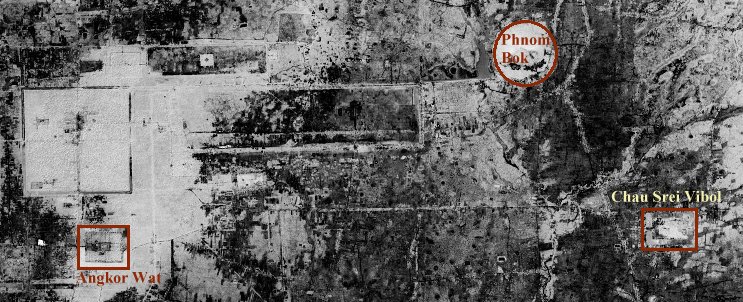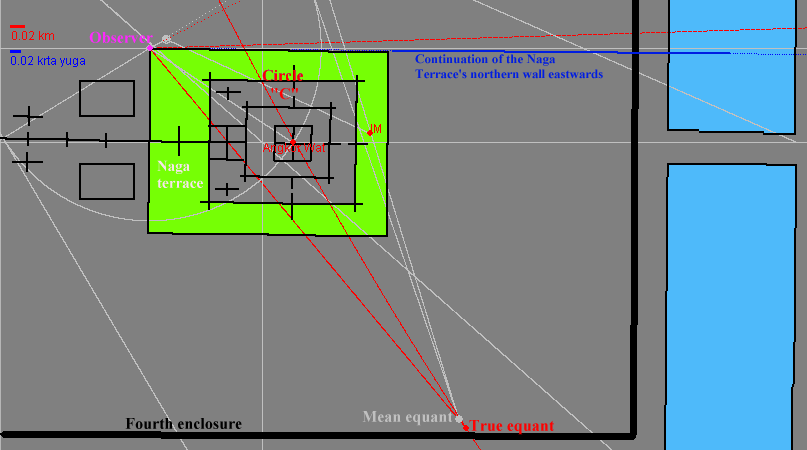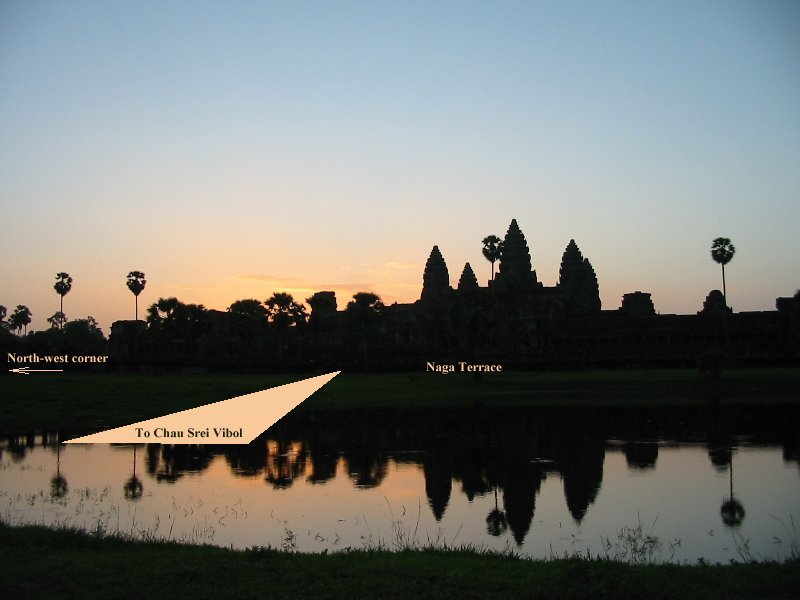

The north-west corner of the Naga terrace of Angkor Wat (Moon’s observer) was also the observer of a Sun’s diagram which organized partially the sacred space of Greater Angkor and its Hinterland.
Rising Sun on Angkor Wat
Courtesy
of Moyra Farrington
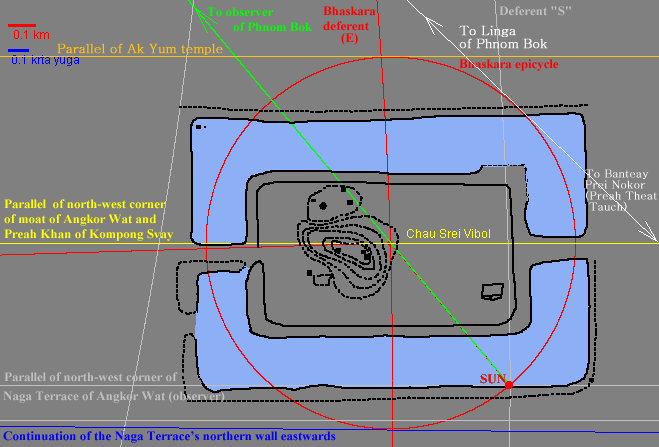
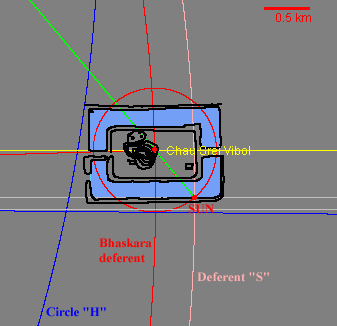
The centre of the Bhaskara epicycle was located on a position which was used as the geometrical centre of the moat surrounding the hill of Chau Srei Vibol. This put the Sun on the inner embankment of the southern moat and, of course, on the parallel crossing the north-west corner of the Naga Terrace of Angkor Wat.
The antidromic (opposite to the direction of the sun) direction of the epicycle's radius was determined to run through the Phnom Bok observer (observer of outer planets). This was possible only by choosing a particular date ie a date when the longitude of the apogee (from sun) was 50.03°.
This occurred on 15/04/967. We’ll see further that this date created interesting relationships between existing material structures (sacred hills and early Khmer sites) and the diagrams of outer planets.
The bond between Angkor Wat, Chau Srei Vibol and Phnom Bok
The diagram of Chau Srei Vibol was related to the Phnom Bok in another way. We discovered indeed that the loxodrome from the giant Linga to Banteay Prei Nokor (Preah Theat Tauch) is tangent to the Bhaskara epicycle. It is worth noting Banteay Prei Nokor is located at 265 km from the Phnom Bok.
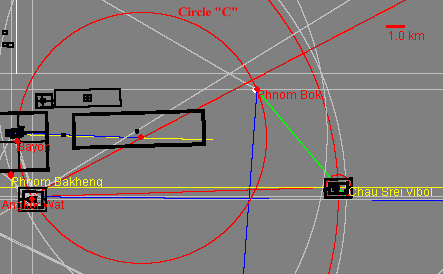
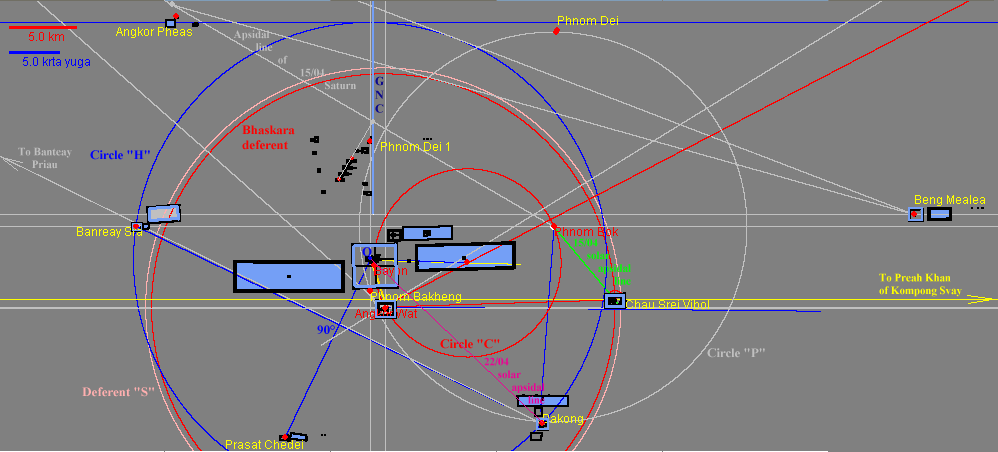
Moreover, the observer’s location on Phnom Bok was related to the Sun’s diagram. It is indeed crossed by the circle “C” (described in the Moon’s chapter) which runs through the Bayon and the central tower of Angkor Wat (Moon).
Now, this circle runs also through the mean equant of the Sun of Chau Srei Vibol and also through its true equant. The latter seemingly determines the latitude of the southern fourth enclosure of Angkor Wat.
We noted two relationships between Angkor Wat and Chau Srei Vibol:
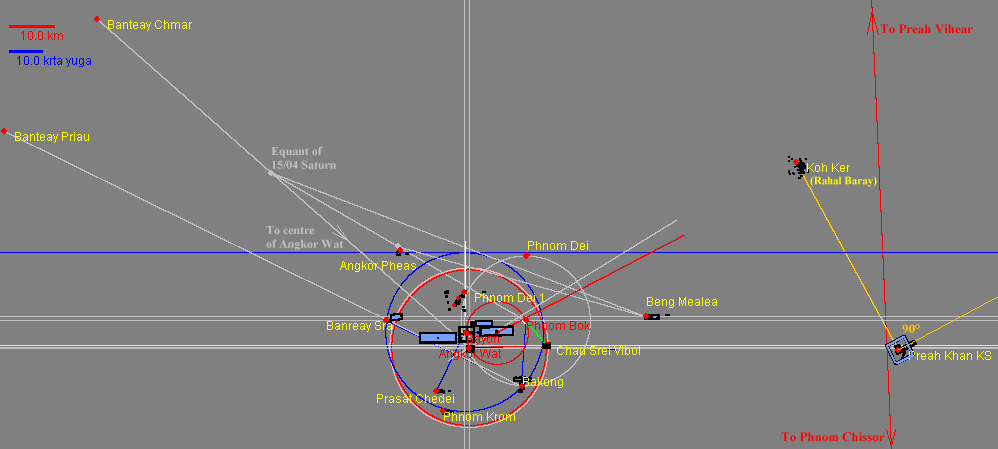
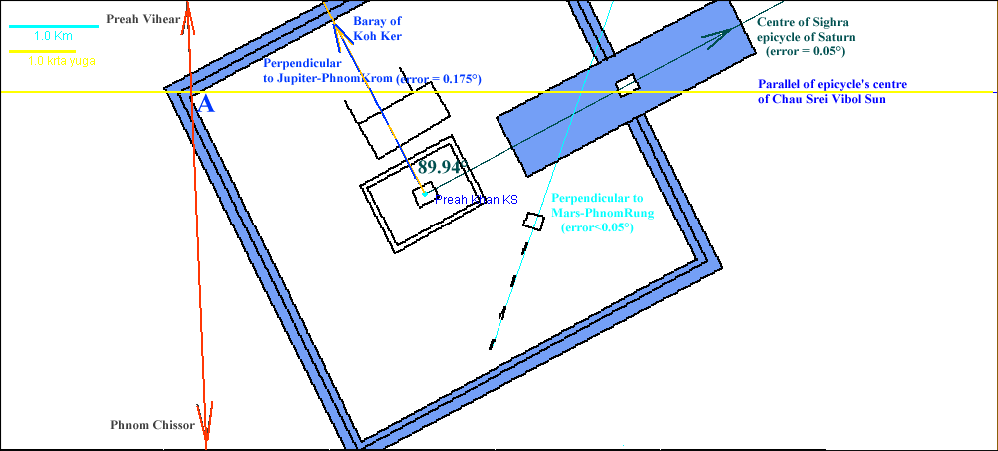
- The north-west corner of the Angkor Wat’s moat was located on the geographical parallel running through the centre of the Bhaskara epicycle of Chau Srei Vibol. The same parallel runs through the north-west corner of the moat of Preah Khan of Kompong Svay.
- The continuation of the Naga Terrace’s northern wall eastwards, is tangent to the Bhaskara epicycle of the Sun.
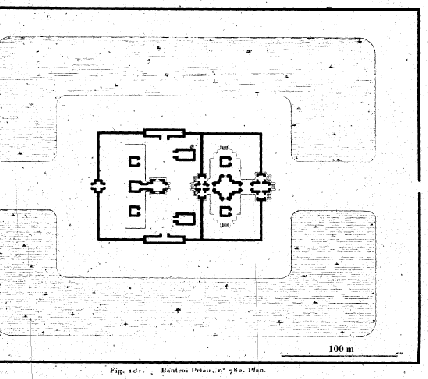
Finally, we discovered that the parallel of the Ak Yum temple is tangent to the Bhaskara epicycle.
The frame of the main hydraulic works
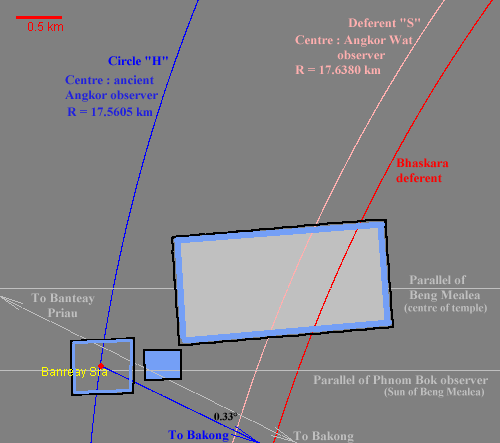
In the context of the Bhaskara model, the circle (centre on the north-west corner of the Naga Terrace of Angkor Wat) running through the epicycle’s centre of Chau Srei Vibol is called “Bhaskara deferent” (red colour). However, in the context of the “concentric equant” model, the circle running through the Sun can be called also “deferent”. This deferent (called here “deferent S” and depicted in pink colour) runs through the centre of the Banteay Sra ’s baray and it is a component of a figure which includes the main hydraulic works of Angkor (we used a map established by the “Greater Angkor Project”)
A parallel through Banteay Sra runs through the Phnom Bok’s observer location. and the 22/04 Sun of Beng Mealea.
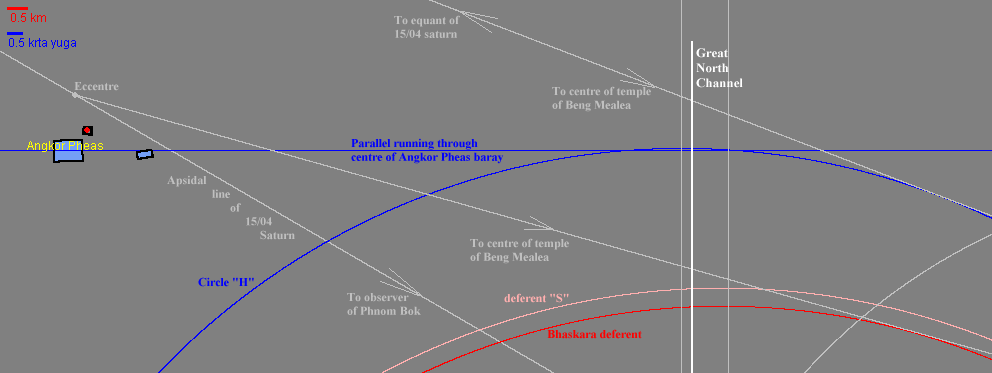
The parallel crossing the baray of Angkor Pheas is tangent to the circle H .
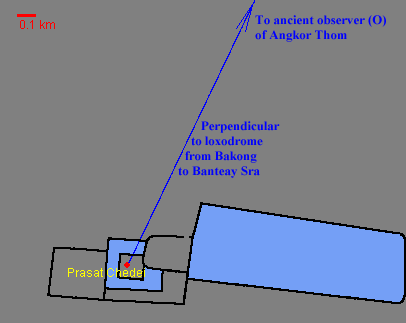
The chord linking Bakong and Banteay Sra is precisely perpendicular to the loxodrome from the centre O of circle H to the temple of Prasat Chedei and nearly parallel (difference = 0.33°) to the loxodrome running, from Bakong, through the remote temple of Banteay Priau (114 km to the north-west of Angkor Wat). It is worth noting that, according to an inscription discovered by Aymonier, the sanctuary of Banteay Priau was called “Thpvan Rman” ie “head of axis”.

It should be noted the temple of Beng Mealea, which is surrounded by one of the biggest moats, establishes a relationship between the circle “H” and the Bhaskara deferent (the circle running through the centre of the Sun’s epicycle). The centre of this temple is indeed precisely located on the intersection of the following loxodromes :
- a loxodrome running through the equant of 15/04 hinterland Saturn and tangent to the “H” circle.
Reminder: “H” is the circle having the same radius as the deferent “S” (which runs through the Sun) but whose centre is the observer location (O) within Angkor Thom .
- a loxodrome running through the eccentre of 15/04 hinterland Saturn and tangent to the Bhaskara deferent.
The errors are practically nil.
We see there are relationships between the two “luminaries” centered on Angkor Wat and the apsidal line of 15/04 hinterland Saturn. (Moon’s chapter)

BANTEAY PRIAU
Lunet de La Joncquière - Inventaire descriptif des monuments du Cambodge, tome troisième,
page 374
Preah Khan of Kompong Svay
It is worth noting that, In 1018, Suryavarman I consecrated three Linga to delimit
his kingdom. They were located in:
-Preah Vihear
- an unknown place, somewhere to the East, near the Mekong River
- Phnom Chissor
Suryavarman built also the monuments of Chau Srei Vibol and the city of Preah Khan
KS.
Now, we have established that the north west corner of Preah Khan KS 's moat was
located on the intersection of the parallel of the epicycle's centre of the Chau
Srei Vibol Sun with the loxodrome from Phnom Chisor to Preah Vihear.
This relationship between history and geometry is remarkable.
A figure related to the zenith culmination of 15/04/967 (Julian calendar)
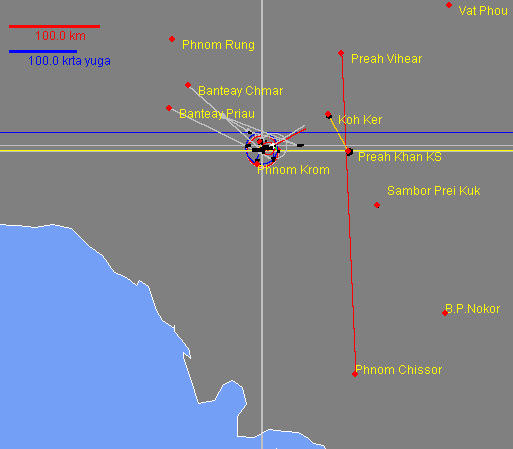
We have seen in the previous chapter there is a relationship between the Sun’s diagram
and the site of Phnom Chissor, a sacred hill situated 267 km to the south-east of
Angkor Wat. Now, Phnom Chissor is located on the parallel where the zenith culmination
of the Sun occurs on 20/04 in the Gregorian calendar. During the year 967, the corresponding
Julian date was 15/04 ie the date of reference of the later diagrams we are describing.
Note: It is worth remembering we use the Julian calendar to obey the usual convention
of the historians although the Gregorian calendar, which does not shift with respect
to the seasons, would be more practical in an astronomical context.
The toponymy confirms our hypothesis : the Khmer name for Phnom Chissor was “Suryaparvata”
ie “Mountain of Surya”. Now, Surya was the Sun God.
We’ll see in the chapter on the 15/04 outer planets of the hinterland that the complex
of Preah Khan of Kompong Svay was conceived as a hub. The intersection of the parallel
of the centre of the Chau Srei Vibol Sun’s epicycle with the loxodrome from Phnom
Chissor to Preah Vihear is one component of the hub. Another creates a relationship
with the site of Koh Ker (an earlier hub) which was located on the parallel where
the zenith culmination occurred (and still occurs) on 27/04 (Gregorian), a date which
corresponds to 22/04 Julian during the year 967 ie the reference date of the earlier
planetary diagrams.