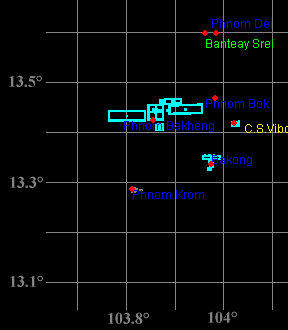

The Khmer kings moved their successive capitals across Cambodia for various political reasons but we suggest they wanted also, in some cases, to obey the rules of sacred geography related to planetary diagrams or, conversely, to use a new location to create or complete a planetary diagram. As an introduction, we’ll describe the peregrinations of the successive kings by noting relevant astronomical relationships that we’ll develop in greater detail in the following sections. We have not investigated in detail the oldest capital, “the city of Western Baray”, which was created during the 7th or 8th century and partly flooded by the water of the big western reservoir during the 11th century. However, we’ll see that its main temple (the Ak Yum) was included in some planetary alignments during the Angkorian period. Below we have bolded the names of the temples or sacred mountains which are components of the planetary diagrams. On the maps, colors represent different epochs: white to the pre-Angkorian epoch whilst blue, green, yellow and red represent, respectively establishments in the 9th, 10th, 11th and 12th centuries.


1) The first Khmer capital, Hariharalaya
was established at the beginning of the 9th century, 20 km to the south-east of the Ak Yum temple, in the Roluos area. It was one of the three capitals founded by the king Jayavarman II, the founder of the Khmer dynasty. His first provisional capital was located in the area of Banteay Prei Nokor, 270 km to the south-east of Angkor. Another was created in the Kulen mountain (Phnom Kulen), 30 km to the north-east of Angkor.
We’ll see that each capital has a related solar line of apsides corresponding to the date in April of the zenithal culmination of the Sun in central Cambodia


During the 9th century, the successors of Jayavarman II built:
- The Bakong pyramid temple, the main monument of the Roluos group and the first major Angkorian wonder. It is a component of one of the lines of apsides.
- The first baray (large reservoir) in the
northern part of the Roluos area.
- The brick towers of Phnom Rung,
a volcanic hill temple located 150 km
to the north-west of Angkor. It is
related to one of the oldest outer planets’
diagrams.
Central shrine of Banteay Srei
Courtesy of Moyra Farrington
3) The third capital, Koh Ker, was established in CE 921 when Angkor provisionally lost its role as the political centre of the kingdom. King Jayavarman IV moved the capital to this remote place located 80 km to the north-east of Angkor. It was a bad location for hydraulic works. This strange affair has never been explained. It was abandoned some 20 years later. Our hypotesis provides a plausible explanation: the main temple of the site, Prasat Thom, “locks” the outer planets’ diagrams drawn around the observer at Phnom Bok.
Guardian lion of East Mebon
Plan of Koh Ker (Aymonier)
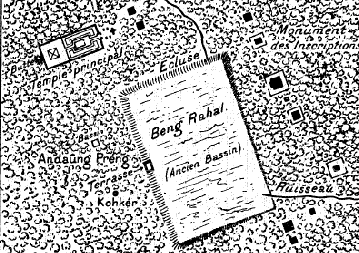
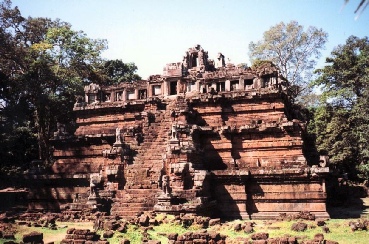
4) The fourth capital, a second Yasodharapura, was, as a matter of fact, one of the components of a twin capital. When King Rajendravarman moved back the royalty to Angkor in CE 944, he founded around the majestic Pre-Rup temple located to the east of the earlier capital, a capital-like city called the “City of the East”. The meridian of this temple determined the location of Venus on a previously drawn Sighra epicycle.
Rajendravarman built, near Phnom Dei, the jewel of Khmer art : the Banteay Srei temple. This temple determined the trajectory of the Sigha epicycle of the oldest Mars diagram.
He also constructed within the Eastern Baray, an island-temple called the “East Mebon”. It was located on the centre of one of the solar Bhaskara epicycles. About CE 1000, the successor of Rajendravarman built the Takeo temple to the West of the East Baray. The latter temple was the main component of the Mercury diagram.
Angkor Wat Courtesy of Moyra Farrington
Beng Mealea Courtesy of Moyra Farrington
Ta Prohm
Courtesy of Moyra Farrington