

We have seen the oldest planetary diagrams, whose reference date was 22/04/967 (Julian), were designed to fit some sacred hills or promontories (Phnom Bakheng, Phnom Bok, Phnom Krom, Phnom Dei, Vat Phou and Preah Vihear ). We’ll see the later diagrams, whose reference date was 15/04/967, were drawn between the second half of 10th century and the beginning of the 13th century. They added other sacred hills (Phnom Rung, Chau Srei Vibol) and the pre-Angkorian site of Sambor Prei Kuk to the scheme while using most of the hilltops of the older diagrams.
By using the north-west corner of the Naga terrace as the observer location, we are able to draw a lunar diagram which obeys the rules established by Munjala, as explained in “The Midnight system of Aryabhata and the lunar model of Munjala”, and which is “locked” by material structures located inside and outside Angkor Wat.
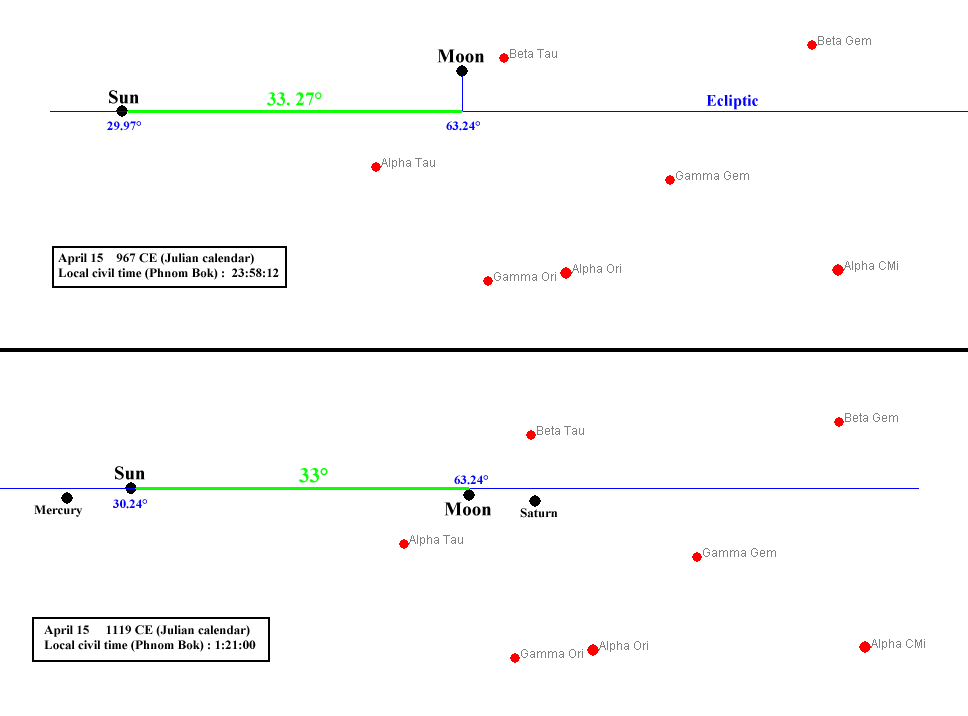
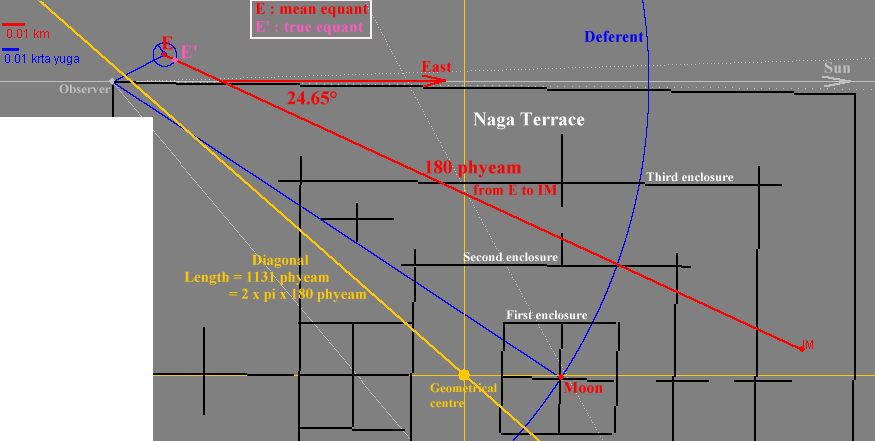
One of the clues which led us on this track is the azimuth of the capstone of Angkor Wat’s central tower with respect to the north-west corner of the temple’s Naga terrace. This azimuth (as usual, from east), is very near the Moon’s ecliptic longitude (as usual, from Sun) on 15/04/967 (Julian) at 23:58 (true local midnight). The error is small (0.13°).
The corresponding
celestial configuration
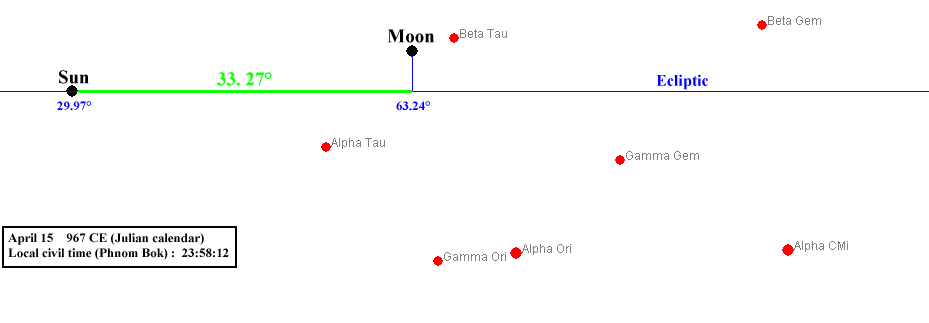
Coordinates of observer (north-west corner of Naga Terrace:
13.413658°
103.864975°
Coordinates of alleged Moon:
13.412474 °
103.866818 °
Azimuth of alleged Moon (as seen from observer) = 33.270 °
Distance from observer = 238.695 m
The Moon would be located directly below the capstone of central tower, 0.54 m to
the south west of tower’s centre
(0.44 m to south and 0.32 m to west)
Angular error = 0.13°

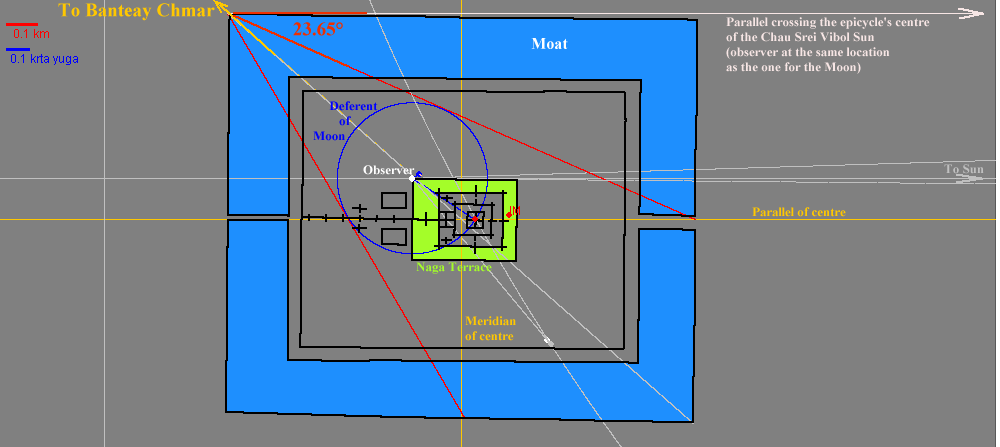
1) The two loxodromes running through the moat's north-west outer corner and tangent to the deferent cross indeed the outer eastern and southern dykes on, respectively, the parallel and the meridian of the temple's geometrical centre. It is worth noting that the tangent which intersects with the east moat has an azimuth of 23.65° south of east. Now, the obliquity was 23.574° on 15/04/967 (planetary event of reference) and 23.552° on 15/04/1119 (coronation of Suryavarman II, the builder of Angkor Wat).
It was not possible to create at the same time perfect points of tangency and perfect intersections with the dykes. In the case of the northern tangent, the intersection is precise but the loxodrome runs at 4 m from the tangency point. In the case of the southern tangent, the point of tangency is fully precise but the loxodrome intersects with the dyke at some 10 m to the east of the centre’s meridian.
By supposing the Moon was located on the central tower’s capstone, it is possible to draw a deferent which is related to the overall structure of the temple :
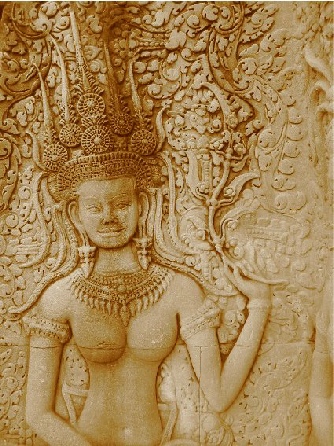
Heavenly dancing girl (« Apsara »)
Courtesy of Moyra Farrington

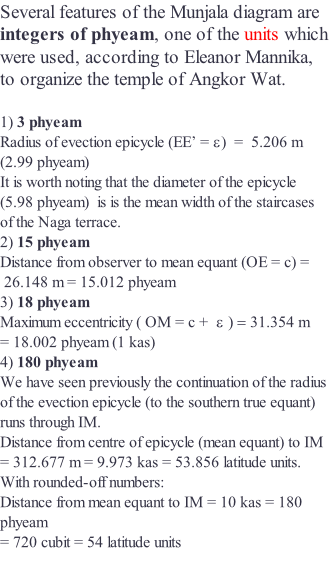
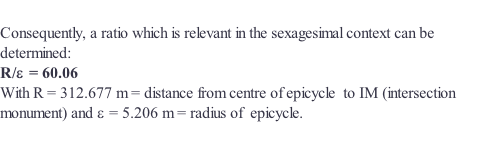
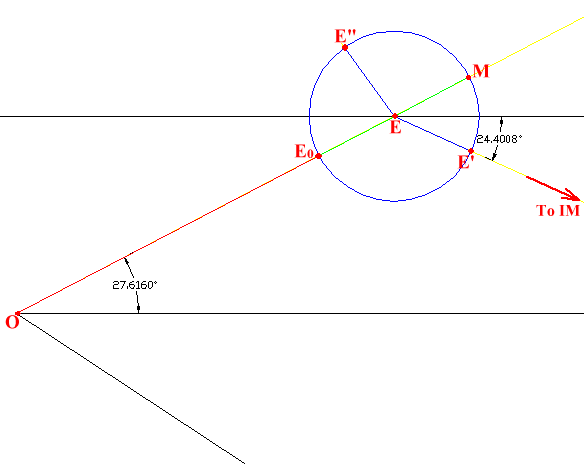
It is worth noting IM is located on the continuation of the radius EE’ of the evection epicycle (error = 0.253°). We’ll see further that IM is a component of the Sun’s diagram whose observer is at the same location as the one for the Moon and whose epicycle’s centre is located on the parallel crossing the moat’s north-west corner.
There are two sites, located outside Angkor wat, which are related to the lunar diagram.
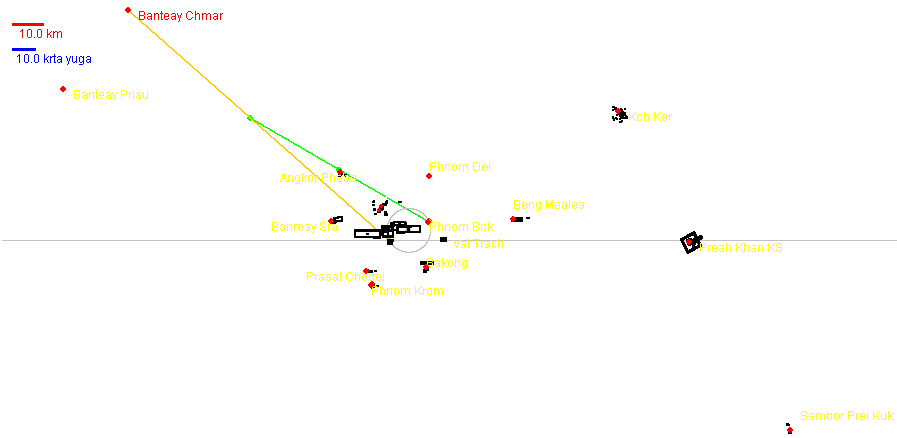
1) The continuation of the moat’s diagonal (azimuth = 41.184° north of west) runs through the equant of the 15/04 Saturn ((green dot, at the intersection of yellow and green lines) and through the temple of Banteay Chmar, the large city founded by Jayavarman VII at the end of the 12th century in an arid region 110 km to the north-west of Angkor Wat (azimuth 41.308° north of west).
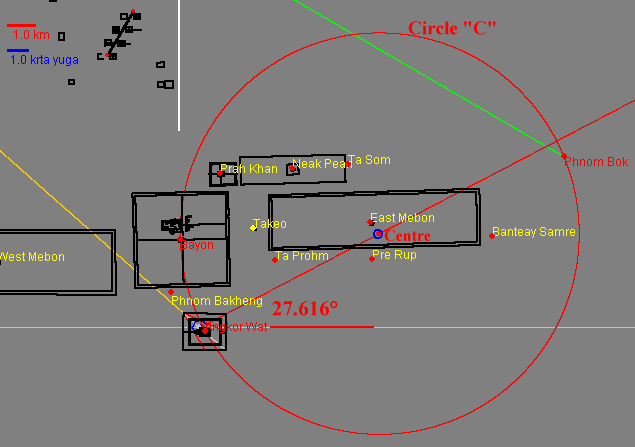
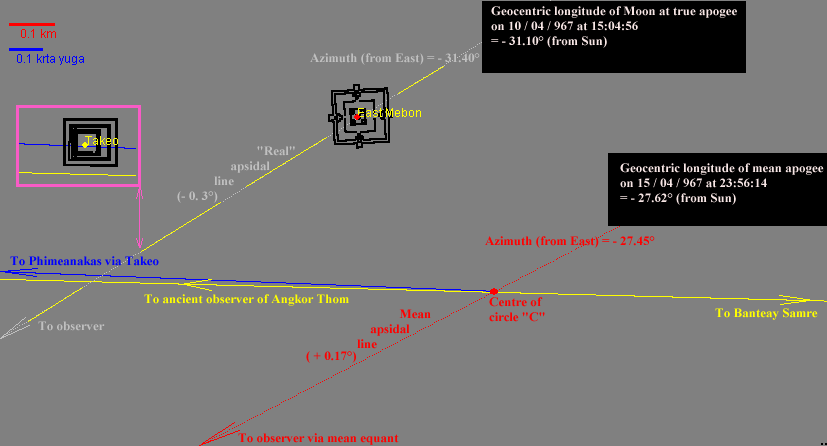
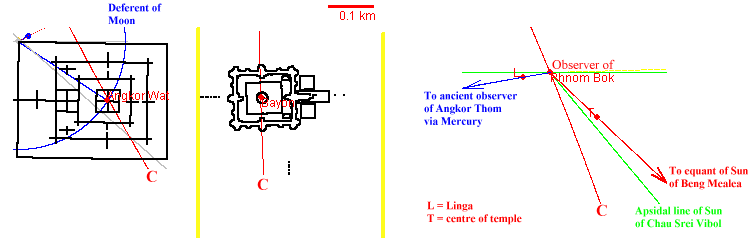
2) The azimuth (from the observer) of the mean lunar equant (ie the mean apsidal line) points towards an interesting location. It is the centre of a big circle (we call this “C”) which runs through the Phnom Bok’s summit (observer of outer planets in hinterland), the Bayon (observer of Angkor proper’s outer planets) and the central tower of Angkor Wat (ie the Moon). We’ll see further this circle runs also through the mean equant of the Sun’s diagram (with the same observer location as the Moon).
Mean equant (centre of evection epicycle):
Coordinates 13.413768 ° N ; 103.865189 ° E
Distance from observer = 26.148 m ()
Azimuth (as seen from observer) = - 27.616°
Centre of “C”:
Coordinates:13.443063° N ; 103.9227988° E
Azimuth (as seen from observer) = -27.452°
Precise trajectory of circle « C » through Angkor Wat, Bayon
and Phnom Bok
The « ancient observer of Angkor Thom » is the
LINKS : Bayon as observer, observer of Phnom Bok, Sun of Chau Srei Vibol, Sun
of Beng Mealea
The lunar diagram of Angkor Wat possibly explains why the founder of the temple, Suryavarman II,
was coronated on CE 1119, six years after the beginning of his reign.
In the middle of the night of 14-15/04/1119, the Moon and the Sun reached the same longitude observed around midnight of 15-16/04/967, eight Meton cycles earlier.
1 Meton cycle = 19 years. Now, there are several “19” in the temple. They have been commented on by Eleanor Mannika in the diagram of Suryavarman’s procession scene (south side of third gallery)
The distance between the centre of the circle and the centre of the central tower
of Angkor Wat is 6942.6 m.
Now, 10 * 54 * 29.530589 cubits = 6943.91 m
With:
29.530589 days = synodic period of Moon and 1 cubit = 0.43545 m.
As Angkor Wat is a lunar temple with many sets of 54 gods and as the Khmers used
the decimal system beside the sexagesimal one, we think this distance is interesting.
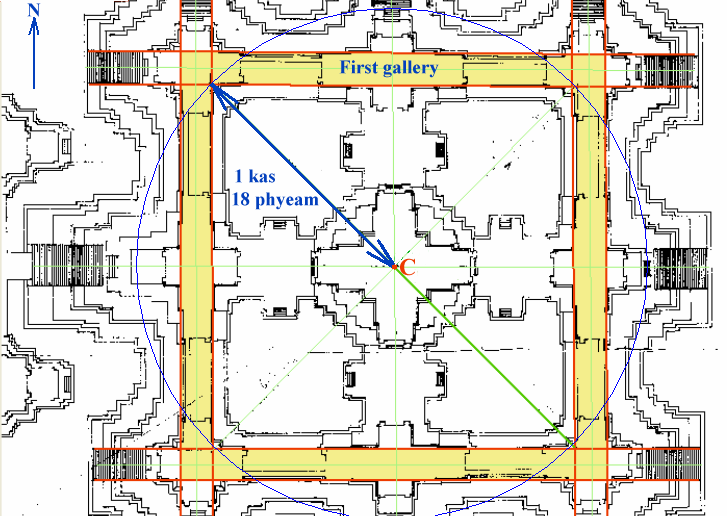
The maximum eccentricity ( c + e = 18 phyeam ) is related to the dimensions of
the first gallery :
A circle having a radius of 18 phyeam and whose centre is the capstone’s finial
( C ) runs indeed through the inner corners of this gallery.
There is perhaps a numerical relationship between the latter radius and the height
of the central structure: according to Eleanaor Mannika, there is indeed a height
of 54 cubits from the roof of the central sanctuary to the top of the tower’s finial.
The same height has been measured by the latter scholar from the sacred deposit to
the floor level of the central sanctuary.
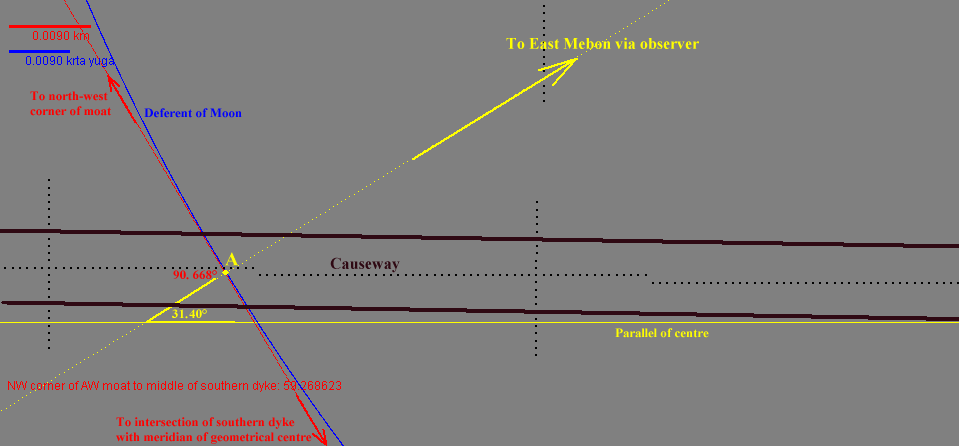
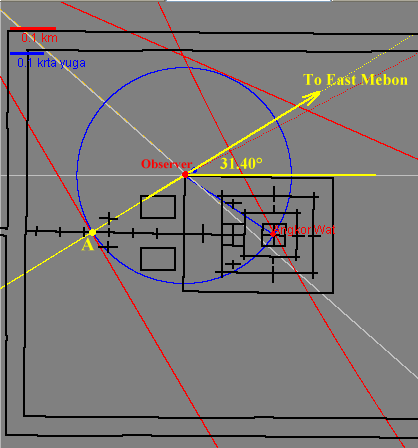
It is worth noting the loxodrome from East Mebon crosses the axis of the causeway very near the location where the loxodrome from the moat’s corner is tangent to the Moon’s deferent.
Two loxodromes cross the mean lunar apsidal line on the centre of the circle « C »
- The loxodrome running through the centres of the Phimeanakas and Takeo temples.
- The loxodrome from the ancient observer of Angkor Thom (observer of 22/04 inner
planets)
to the centre of the Banteay Samre temple.
The Munjala lunar model was designed to calculate the equation of centre and its
correction but it can’t provide the real longitude of the “true” equant. It is nevertheless
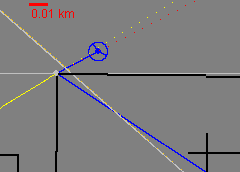
possible this longitude was actually observed. The intersection ( A ) of the deferent
with the causeway is located on the loxodrome from the East Mebon to the observer.
Now, the azimuth of this loxodrome (31.40° north of east) indicates possibly the
location of the Moon (31.10° from Sun) when it crossed its true (real) apogee on
10 / 04 / 967, five days before the date of reference.